Showing posts with label Senninger. Show all posts

Thursday, June 25, 2015

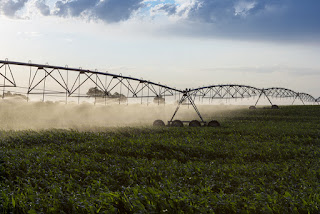
Seven Center Pivot Myths Debunked | by Senninger Irrigation

This piece was written for and published by Senninger Irrigation, and reprinted with permission.

Center pivot technology has come a long way in recent years with improvements to irrigation efficiency and data tracking. As pivot and sprinkler manufacturers develop a better understanding of soil health and the water needs of various crops, technologies change and evolve so farmers can irrigate with less water and less energy, while still keeping the high yields needed to feed the world.

Today, most pivot irrigators have abandoned the inefficient impact sprinklers familiar to most fruit and vegetable growers and replaced them with water and energy efficient sprinkler heads, like LEPA applicators.

They have adopted new monitoring technologies that give them the ability to monitor almost every aspect of the system, from how much water needs to be applied and to when water is delivered. Farmers can also verify a machine’s efficiency and make any necessary adjustments to their pivots easily.


Despite these improvements, there are still many farmers across the world that have never considered center pivots efficient irrigation machines.

We at Senninger have been working with pivots for over 30 years and we firmly believe pivots are and will continue to be efficient and continuously improving machines that save water and energy while helping growers obtain high yields. That’s why we’ve compiled a list of the top pivot irrigation myths and decided to debunk them once and for all!

Myth #1 - Pivots can’t irrigate corners without water wasting end guns.

Farmers who want to try center pivot irrigation but want to continue farming the corners of their fields can add swing arms that attach to the ends of the pivots and water the corners of the fields.

Myth #2 - Pivot sprinklers waste water through runoff and surface soil evaporation.

Some pivot sprinklers are less efficient than others, particularly sprinklers that throw water high in the air. Good quality sprinklers irrigate with large droplets the air can’t steal and distribute water instantaneously over their entire surface area. Spreading out the droplets over a large area helps preserve soil’s intake rate and ability to absorb water.

Myth #3 - Pivots can’t be used with crops prone to foliar disease, like tomatoes.

Pivot sprinklers are extremely flexible! A spray head like the Senninger LDN can be used in spray mode to germinate fields as a growing season begins. Then it can be switched to LEPA bubble mode, which avoids wetting crop leaves. The sprinkler can also be converted to a drag hose if necessary.

Myth #4 - Pivots can only irrigate a limited number of crops like corn or cotton.

Did you know pivots are used to irrigate rice, tomatoes and sugar cane? Growers with center pivots are free to rotate crops every season, change row spacing or switch between high and low profile crops. It’s easy to modify pivots to irrigate different types of crops – most of the changes have to do with sprinkler height and application rate – and they are easy to move out of the way when it is time for planting or harvesting.

Myth #5 - Pivots are way more expensive than other systems.

The price of a pivot may seem overwhelming at first, but investing in a pivot means you invest in an irrigation system that can last up to 25 years. Pivots are very easy to maintain. Most of what you pay is for the system itself – you won’t have to worry about filtration, checking the system for rodent damage, system flushing, air discharging, etc. Moreover, if there comes a moment when a component needs repairs, fixing the components will not lower the system’s overall application efficiency.

Myth #6 - Pivot technology is always changing so there’s no point in buying something that will soon be outdated.

The main components of a pivot will last for decades. Add-ons like GPS control, automated system control and Variable Rate Irrigation Technology can be installed long after the pivot is purchased so growers always have the option of keeping up to date with the latest technologies. Sprinklers and pressure regulators can be easily replaced when they wear or if new technology becomes available.

Myth #7 - Sprinklers use too much water and energy.
Sprinklers use anywhere from 0.27 to 30 gallons of water per minute and they only need 6 to 20 psi to operate, depending on the model selected.


Senninger® Irrigation
A Valley® Irrigation Authorized Provider

Founded in 1963, Senninger Irrigation, Inc. is one of the world’s leading manufacturers of agricultural irrigation products. These include sprinklers, spray nozzles and pressure regulators. Senninger products are made in the United States and sold worldwide through qualified dealers. Products can be found in farms, nurseries, greenhouses, open fields, as well as mining operations. Senninger is dedicated to low pressure, high performance irrigation solutions. 


This post was written by Nicole Alvarez, the technical writer for Senninger.

Monday, May 18, 2015

LDN Bubblers Maximize Irrigation Efficiency on the High Plains | by Senninger Irrigation


Here at Senninger® Irrigation, we know growers in the High Plains region are concerned about water availability.

Persistent drought conditions in the area are forcing many growers to pump more water from the Ogallala Aquifer, with some depending almost solely on the aquifer to maintain soil-moisture levels. Growers in this windy and semi-arid region also face a greater likelihood of water loss due to evaporation and wind-drift. Our Senninger team knows these conditions make it even more difficult to meet high yield demands and maintain crop quality.


That is why many growers across the region are replacing their sprinklers with our Low Drift Nozzle (LDN) Low Energy Precision Application (LEPA) Bubblers.

Growers already know that not all of the water they pump reaches crop roots. Water is prone to evaporating before it reaches the soil. It can even evaporate directly from the soil surface. Soil is also likely to overheat, crack and lose its ability to effectively channel water down to the crop’s root zone.

LEPA Bubblers help growers get around these issues by applying water around 8 to 18 inches above the soil surface and directly into crop furrows. Keeping water so close to the ground helps avoid wetting crop leaves and reduces the amount of water lost to wind-drift and evaporation. That means nearly all the water pumped is absorbed by the soil.

Research by Leon New and Guy Fipps of Texas A&M shows that spray heads can experience a 17 percent water loss at wind speeds of 15 mph. With LEPA sprinklers, at least 20 percent more water will reach the soil surface compared to conventional spray nozzles. Conventional sprinklers are very susceptible to high wind speed, low relative humidity, temperature and evaporation losses.1

Growers are also discovering that installing LEPA Bubblers on fields where they use strip-till or no-till increases soil moisture and reduces runoff and soil sealing. Crop residue protects the water from evaporation while simultaneously protecting the soil from drying out and overheating.

Others are taking LEPA irrigation a step further and doubling their drops from traditional 60-inch increments to tighter 30-inch spacing between heads to more uniformly soak the soil. The benefits of this closer spacing include less water usage, more uniform root zone coverage during pre-watering, reduced dry spots and high yields despite restricted water supplies.

“Using 30-inch spacing with Bubblers gets the job done with less energy, and nearly all of the water pumped is absorbed by the soil,” says Edwin Smith, High Plains regional sales manager for Senninger Irrigation. “There are certain aspects growers need to be aware of before making a switch to this method, but with the right conditions growers could potentially increase their yields and reduce their costs.”

These ideal conditions include relatively flat land, circle planting and crop residue. The maximum recommended slope for growers considering LEPA or close spacing installations is 1 percent. Planting in circle rows is necessary to increase uniform water disbursement and reduce runoff, while crop residue is needed to increase surface storage capacity and prevent soil redistribution. While just about any type of soil will benefit from close spacing, it is important to consider each soil’s water-holding capacity when setting up close spaced Bubblers. Some soils, like porous sandy soils, can handle much higher application rates than others.


1 LEPA Conversion and Management by Dr. Guy Fipps and Leon New


Reprinted from Valley PivotPoint magazine, Spring 2015

Thursday, February 19, 2015

Connecting Pressure, Flow and Your Overall Efficiency | by Nicole Alvarez

This piece was written for and published by Senninger Irrigation, and reprinted with permission.

Our team has traveled all over the USA and across the globe and noticed two strange things when it comes to pressure regulation: some growers will tell you that pressure regulation is the best way to save water and energy, while others will claim pressure regulation is nothing but a waste of time and money unless you have sloped fields.

We’ve been highlighting the importance of pressure regulation for years but regulation has never been as important as it is now with drought conditions in numerous areas and diminishing aquifer levels. That’s why we’ve created a quick pressure regulation FAQ list to help explain not just how a regulator works, but why they’re needed and how you can tell if yours is working.

How does a pressure regulator work? 


The basic function of a pressure regulator is to limit excessive and varying inlet pressures to a constant outlet pressure. This is done to maintain the desired performance of a sprinkling device.

Pressure regulators accomplish this by automatically modulating their area of opening. By changing the area of opening as upstream pressures fluctuate, pressure loss through the regulator changes proportionally. This allows them to maintain the downstream pressure at a relative constant.

Why do I need pressure regulators?

No matter what type of irrigation machine you have, correct pressure is essential for optimum distribution uniformity and proper flow through emitters. Crops need the right amount of water at the right time and pressure regulators ensure this need is met.

Sprinklers are made to operate within a specific range of flows and pressures. They’ll maintain their application pattern and adequate droplet size as long as they can operate under normal conditions. If these conditions are altered, their application pattern will be affected and you could easily run into uniformity issues, over or under watering, and irregular crop growth.

What causes pressure deviations?

Every irrigation machine will experience some sort of pressure fluctuation. The most common reasons for pressure fluctuations include:

  • Elevation changes in a field 
  • Pressure loss through pipe fittings 
  • End guns cycling on and off 
  • Cycling of various irrigation zones and valves 
Do I need a pressure regulator with flat land?

Yes! Your system pressure can change due to the various causes listed above and more. Elevation is just one of the many things that cause pressure fluctuations.

No matter what degree of elevation you have, controlling flow and pressure is essential for machines operating at lower pressures. For example, if a system operating at 30 psi (2.07 bar) experiences a 10 percent flow variation, that will result in a 6 PSI (0.41 bar) pressure variation. That flow variation can adversely impact sprinkler performance and ultimately yields.

How does pressure affect my flow rate?

The operating pressure of an irrigation machine always affects the flow rate. Higher pressures increase flow along any pipe. As that flow increases, water velocity increases as well. This results in pressure decreasing downstream due to friction loss. When water is rushing through a pipe at high velocities, the interior walls of the pipe create friction against it, which causes pressure loss.

How long does a pressure regulator last?

Senninger pressure regulators are built using high-impact engineering grade thermoplastics and are 100 percent water-tested at our facilities. However, like sprinklers, they do not last forever. Irrigators are encouraged to check their pressure regulators at least every three years. Factors that can shorten a pressure regulator’s lifespan include:

  • Unflushed chemicals in the pipeline 
  • Suspended abrasive materials in the water 
  • Long operating hours 
How can I tell if a pressure regulator is bad?

Issues such as dry spots near the head, overwatering in a doughnut shaped pattern, uneven crop growth and streaking in the field and misting are all common signs of pressure regulator malfunctions. Using yield maps and even aerial imaging may prove helpful in identifying issues.


Senninger® Irrigation
A Valley® Irrigation Authorized Provider

Founded in 1963, Senninger Irrigation, Inc. is one of the world’s leading manufacturers of agricultural irrigation products. These include sprinklers, spray nozzles and pressure regulators. Senninger products are made in the United States and sold worldwide through qualified dealers. Products can be found in farms, nurseries, greenhouses, open fields, as well as mining operations. Senninger is dedicated to low pressure, high performance irrigation solutions. 


This post was written by Nicole Alvarez, the technical writer for Senninger.

Thursday, September 11, 2014

End-of-Season Checklist | by Nicole Alvarez

This piece was written for and published by Senninger Irrigation, and reprinted with permission.

This year’s irrigation season is ending for many farmers across the western hemisphere. Several are already working in their combines and reaping the fruits of their labor.

It’s tempting to forget about pivots and just focus on getting crops out of the field and into a bin during harvest. Yet this is one of the best times to evaluate sprinkler packages to make sure your pivots are in top shape and ready for another growing season. This check helps prevent unwanted surprises and helps ensure crops will be irrigated according to schedule. 

We suggest you take a look at this end-of-season checklist for a quick overview of the things you should take care of:

1. Get Your Sprinkler Package Chart
Find a copy of the sprinkler package chart. This contains the location of all sprinklers and pressure regulators along the center pivot. It will also include detailed information for each sprinkler’s nozzle size or flow rate. You’ll need it a little later when you’re walking along your pivot verifying sprinkler location and noting potential issues.

2. Flush Your System
Check the main pipe running from the well to the pivot itself for any potential leaks. Next, remove the sand trap on your pivot and flush the entire system for several minutes. (Make sure the system is not under pressure when you remove the sand trap!) This will flush out any debris or foreign materials that may plug the sprinkler heads or pressure regulators.

Sprinklers on the first few spans are particularly prone to plugging due to their smaller nozzles size so we recommend a good system flush at least once a year.

3. Check System Pressures
Using a pressure gauge, verify your pressure at the pump, pivot point, and at the end of the pivot. Make sure you operate the center pivot  at the design pressure.

Pressure should be at least 5 PSI above the pressure regulator rating. If you have a 10 PSI pressure regulator, your pressure gauge should read a minimum of 15 PSI. Compare the numbers to the design pressure in your sprinkler package chart to make sure everything matches.

Note: It’s best to check pressure with the pivot parked in the same location!

4. Check System Flows 
Sometimes farmers discover that the nozzles along each span do not correspond with what the printout indicates. This is why it’s important to keep your chart on hand

Check the system flow rates by comparing each sprinkler to the corresponding outlet on the chart. Each sprinkler’s nozzle and flow rate should match the number on the sprinkler package chart. If the nozzles are wrong, you may be over or under watering.

If you have a flow meter, verify that it’s taking the correct measurements. Solving issues like a flow meter not receiving a signal or unstable flow rates might require a little detective work on your part using your flow meter installation and troubleshooting guide.

5. Evaluate Sprinkler’s Wetted Patterns
Visually inspect all sprinklers for potential damage, lost parts, and for consistency and uniformity in their distribution patterns. Assure that sprinkler overlap is sufficient.

Disassemble any sprinklers with poor distribution patterns or overlap and check for plugging or defective parts. Sprinklers can wear out and will stop rotating – or rotate out of control. Check sprinkler deflector pads to ensure they do not have a build-up of materials that could affect the distribution pattern or flow rate. You might also notice kinked or damaged drop hoses that need fixing.

Sprinkler issues can result in extra water being applied is some areas and insufficient water being applied in others. This affects water application uniformity and can reduce yields.

According to the University of Nebraska-Lincoln, depending on the location of the problem along the pivot pipeline, the economic impact of a single sprinkler problem can be significant in the amount of yield reduction it causes. This is especially true for sprinklers on the outer 30 percent of the center pivot.

If You Notice Something’s Off….
Hopefully, you won’t notice any runoff or a lack of uniformity while inspecting your sprinklers, but if you do:
  • Go back to your sprinkler package chart and check the nozzle sizes and placement of sprinklers that are showing problems – they may be incorrectly installed.
  • Consider evaluating your tillage practices to enhance infiltration and decrease runoff.
  • Evaluate your system and consider whether a new sprinkler package would be beneficial. Select a sprinkler device that irrigates with low application intensity over a large diameter, and creates relatively large droplets that can combat wind-drift and evaporation.
  • If you want to renozzle your system, check with your local power company for possible incentives when you switch to lower pressure systems.


Senninger® Irrigation
A Valley® Irrigation Authorized Provider

Founded in 1963, Senninger Irrigation, Inc. is one of the world’s leading manufacturers of agricultural irrigation products. These include sprinklers, spray nozzles and pressure regulators. Senninger products are made in the United States and sold worldwide through qualified dealers. Products can be found in farms, nurseries, greenhouses, open fields, as well as mining operations. Senninger is dedicated to low pressure, high performance irrigation solutions. 


This post was written by Nicole Alvarez, the technical writer for Senninger.

Thursday, July 4, 2013

2013 Valley Field Days | by Kelly Cox


In years past, we have hosted field days dedicated to rice production under center pivots and linears. This summer, we are expanding the focus of our field days to include sessions on other crops and irrigation equipment! Below are the our field day dates, locations, and topics.

Friday, July 26 | Ames, NE

Time: 8:00 AM - 3:00 PM
Location: Taylor Farms | 1969 Country Rd 14 Blvd | Ames, NE 68621
Topic: Corn and Soybeans


Monday, August 26 | Fair Oaks, IN

Time: 8:00 AM - 3:00 PM
Location: Fair Oaks Dairy | 856 N 600 East | Fair Oaks, IN 47943
Topic: Wastewater Management


Monday, September 9 | Minden, NE

Time: 8:00 AM - 3:00 PM
Location: CSS Farms | 2016 32 Road | Minden, NE 68959
Topic: Vegetables and Potatoes


For a list of presentation topics and speakers, and to register for one or all of the field days, visit ValleyIrrigation.com/FD2013. 

We look forward to seeing you this summer!


Kelly Cox
Global Digital Marketing Manager

Kelly joined the Valley Irrigation Global Marketing Department in 2008. Her love of all things geek (steampunk furniture, anime, Doctor Who, and science fiction/fantasy literature, just to name a few) helped shape her appreciation for technology and the web. Kelly is a newlywed and new homeowner, where she shares her geekery with her husband and cat Kiba. She considers herself a wine connoisseur (though, 3 buck Chuck is delicious!) and has a love of painting, dance, and singing.

Saturday, June 1, 2013

Low-pressure Sprinkler Technology for Center Pivots and Linears | Leading the Way in Water Application

Originally posted in the Spring 2009 edition of PivotPoint.

Consider what low-pressure sprinkler technology can do for your operation.

If your center pivot or linear machine is currently running at high pressure, consider this: low-pressure sprinkler technology effectively operates at 10-20 PSI, both reducing your input costs and protecting soil integrity. It also allows for precise application in different zones. This not only helps those producers in areas where water restrictions are an ever increasing concern, but any producer who is interested in more managed and uniform irrigation for crops, less soil disruption, and lower operating costs.

“Efficiency and uniformity are important factors in water application,” explained Jerry Gerdes, Water Application Product Manager at Valley® Irrigation. “Water droplets must be large enough that wind won’t evaporate or blow them away, but not too large to create run off and soil disruption. The challenge for our sprinkler suppliers is to create sprinklers that work at the highest efficiency, getting as much water in the ground as possible, while avoiding those traditional problems.” According to Gerdes, rotating sprinklers available through the Valley product line have been able to strike this balance.

Doug Muscott, a sales engineer with LAD Irrigation in Othello, Washington, agreed. “I’ve been designing and selling irrigation equipment for more than 30 years, and I know that what matters to the grower is good engineering. Sometimes people get caught up in the flash of what’s new, but in the end it is about delivering the right amount of water for that crop. The new technology being used at Valley does this.” 

“The low-pressure equipment now available is designed to deliver optimal irrigation water within the important parameters – soil intake rate, water holding capacity of the soil, climate and water needs, and of course the type of crops being farmed,” he added.

There are additional benefits to using low-pressure sprinklers, according to James Burks, President of Senninger® Irrigation, a Valley sprinkler supplier. “The trend is to cut back on water available for irrigation. Producers are asked to produce sufficient crops to feed a burgeoning world population and be profitable with less water, so water efficiently making its way to the plant is of huge importance. If we can provide high pattern integrity and low pressure application, we can help growers do so,” he shared.

Watch the video below for a demonstration of Senninger i-Wob UP3 sprinklers on a center pivot.  For more Senninger sprinkler video demonstrations, visit their YouTube Channel.


Jim Reid, co-owner of Reid Brothers Irrigation in Unadilla, Georgia, sees low-pressure sprinklers helping growers using zone application as well. “For the producers we work with who grow multiple crops, these low-pressure sprinklers are ideal. Using one of the Valley panels, like the Select2 or Pro2, they can put out different rates of water in each section, varying the amount of water on designated areas of the field. This eliminates the need to guess what time you must be in the field to slow the water down. It can now be automatically adjusted, even at low pressure.”


Valley has long been a leader in developing this technology and bringing it to growers. Along with their sprinkler partners, Nelson® Irrigation and Senninger Irrigation, they’re bringing the latest solutions to growers nationwide. Muscott believes the leadership of Valley within the industry in the area of low-pressure sprinklers comes from their dedication to not only engineering research and development, but staying on the forefront of the technology involved.

Watch the video below for a demonstration of Nelson A3000 Rotator® sprinklers on a center pivot.  For more Nelson sprinkler video demonstrations, visit their YouTube Channel.


“Water application specialists at Valley Irrigation are certified by the Irrigation Association, which indicates their dedication to staying at the forefront of irrigation technology. This is important for growers, because these are the same people dealers call for assistance when they are helping growers determine how to build a sprinkler package that will meet their particular needs. If you tie a grower to the wrong sprinkler package, it can have damaging effects on their bottom line. All input costs have inflation factors – including irrigation water and the energy necessary to get it to the crops. Costs will inflate, but commodity prices do not – they are volatile,” Muscott explained.


“The good news is that Valley, and their dealer network, not only has the advanced equipment, but the knowledge, the engineering experience and the insight to understand how best to apply the technology to the bottom line: helping growers do more with less,” he concluded.


For more information on water application packages for your center pivot or linear, contact your local Valley dealer or leave your comment below!

 Want PivotPoint newsletter articles the minute they become available? Subscribe today!