Thursday, May 22, 2014

Valley Values – Responsive | by Matt Ondrejko

In prior posts, I have discussed three of the five pillars of what we call “Valley® Values.” Those three pillars; Reliable, Durable and Precise, are the backbone of what has made Valley the leader in precision irrigation and the best in the world. But today’s pillar – Responsive – is something that growers have come to associate with the Valley brand promise – something that comes with owning the world’s best irrigation equipment.

I could explain all the ways in which Valley equipment, our manufacturing process, and our technology are Responsive to evolving needs of growers and the demands of today’s changing world. Instead, I will focus on what truly sets us above the competition globally, our Valley dealer network.

Your Valley dealer is the one who is most Responsive to your needs, demands and urgent requests. Your Valley dealer is the one who can service a down pivot on a moment’s notice, or help you load your VRI prescription with ease and confidence. Your Valley dealer is the person beside you in the field during a drought or after a storm has caused damage, developing a plan to get your operation working as soon as possible. Your success is his success and vice versa.

We, at Valley, select and appoint our dealers with the utmost care and attention. They must be the best at what they do, they must be willing to do whatever it takes to keep you up and running, and they must bleed Valley blue! Valley dealers represent the true meaning of Responsive. We are as lucky as you to have a team of dealers that make us all successful!

The Valley dealer network = Responsive!


Matt Ondrejko

VP Global Marketing

The one word that can sum up Matt is "enthusiasm!" He likes to be on-the-go and have fun along the way. Matt loves music and the 1980s era. He is a child of the MTV generation and has a deep appreciation of all music genres (specifically, he is a huge Dave Matthews Band groupie). Matt has traveled to more than 70 countries around the world and enjoys learning about different cultures and people. He spent three years living with his family in Leuven, Belgium, trying to enjoy as many of the 700+ beers they brew there.

Monday, May 19, 2014

Valley Is Proud to Support Cancer Research | by Shannon Peterson

There comes a point in life when nearly every person is touched by cancer. Whether it’s a colleague, a friend, or a family member, you likely know someone who has fought that battle.

In Nebraska alone, there are more than 9,000 new cases of cancer diagnosed every year.

Those of us who are lucky become survivors. Others are not so lucky.


Valley® is working to make a difference in the fight against cancer by donating a center pivot for the live auction at the Cattlemen’s Ball of Nebraska. The Ball is an annual event that raises money for cancer research.

The winning bidder will receive a 1,300-foot, fully loaded Valley 8000 series seven tower center pivot. And, thanks to 21st Century Water Technologies in Scottsbluff, the pivot will be delivered and installed in the winners’ field.

The Cattlemen’s Ball donates 90 percent of the money raised to the Fred & Pamela Buffett Cancer Center at the University of Nebraska Medical Center in Omaha. The other 10 percent stays in the host community to support local health care. Through the years, the event has raised more than $9.8 million dollars for cancer research.

I invite you to take a moment learn more about the Cattlemen’s Ball, which is being held June 6-7 in Harrisburg, Neb., and the Buffett Cancer Center. Or, consider supporting cancer research in your area. As a 10-year survivor, I can attest to the difference every dollar can make.


Shannon Peterson
Marketing Content Editor

Shannon joined Valley Irrigation in 2013. She enjoys traveling with her family, particularly to national parks, and she occasionally writes about her travels for tourism magazines. Shannon also likes reading, trying new restaurants, seeing movies, and watching Husker football and Creighton basketball. However, she and her husband spend most of their free time chauffeuring their teenage son to activities and chasing their baby daughter.

Thursday, May 15, 2014

PolySpan…What Is It and Why Is It Better? | by John Kastl

Over the years, we've fielded many questions about Valley® PolySpan®, but recently we've seen increasing interest. As you may know, groundwater quality has been changing across the country1, leading many growers to investigate pipeline materials that are more resistant to corrosion than galvanized pipe. 


Here at Valley, we've tested numerous corrosion solutions, including aluminum, stainless steel, weathering steel, and a wide variety of paints, linings, and other coatings. From that research, we’re convinced that PolySpan is the best corrosion solution for just about any corrosive water situation.

So what is PolySpan and how can it help you improve your irrigation equipment and increase the efficiency of your operation?

PolySpan consists of a High Density Polyethylene liner and glass-reinforced nylons couplers installed into a hot-dip galvanized pipeline. The entire span and overhang is lined (up to 36’ overhangs), and a 304 stainless steel adapter is used to accommodate the flush-out and mount the booster pump. Optional stainless steel pivot riser pipes and lower elbows are available for a completely corrosion-resistant solution.

PolySpan starts with a steel pipe that is welded and hot-dip galvanized. Then, a poly liner is installed into the pipe. The ends are hot-formed onto the flange and through small retention holes in the flange to create a highly-durable HDPE pipe gasket that locks the liner into the pipe. Finally, self-locking 3/4-inch glass reinforced nylon couplers are installed on the top of the pipe by skilled Valley technicians. These couplers have a wide gasket face that conforms to the inside of the liner for a leak-free seal. Since 2005, PolySpan has been manufactured in Valley, Nebraska, USA, at the same factory where we make the Valley gearbox.

Unlike other so-called corrosion-resistant pipe, PolySpan is an inert material and resists all corrosive elements in irrigation water. There’s no limit on pH, sulfates, chlorides, softness, or saltiness. Also, PolySpan is an excellent choice for growers wanting to take advantage of today’s wide range of chemicals and fertilizers that can be applied through irrigation water. With PolySpan, you don’t have to worry if those chemicals are harming your pipeline. And, because PolySpan is inert, you’ll be able to take advantage of future additives, even if they’re corrosive.

Valley is so confident in PolySpan’s performance that we offer a 20-year, pro-rated corrosion warranty with full replacement for the first 10 years (or 30,000 hours). In fact, the first PolySpan machine was installed in Utah in 1992 and it is still operating.


Valley PolySpan features special hose drops. These strain-relieving drops isolate the coupler from weight, wind, and crop loads present on the sprinkler package. This ensures the coupler is not damaged and remains leak free. Highly corrosive water can also damage the external structure, and hose drops help minimize this. For extremely corrosive water, Valley offers a powder-coat-over-galvanized Drive Unit for additional protection.

Valley PolySpan is available on center pivots, towables and linears; on both the 7000 and 8000 series; and in span lengths ranging from 115 feet up to the industry-leading 225-foot span. It’s also available in both 6 5/8 inch and 8 5/8 inch pipe to accommodate a range of machine lengths and flow rates. Finally, PolySpan is available on the Valley Precision Corner® and is compatible with the Valley Bender30™, so you can maximize your irrigated acres, even if you have corrosive water!

As you can see, because PolySpan is completely insensitive to water chemistry changes and to a wide range of chemicals and fertilizers, it protects the significant investments you’ve made in irrigation equipment.

Lindsey and Rupert. Methods for Evaluating Temporal Groundwater Quality Data and Results of Decadal-Scale Changes in Chloride, Dissolved Solids and Nitrate Concentrations in Groundwater in the United States, 1988-2010 

U.S. Geological Survey Scientific Investigations Report 2012-5049


John Kastl
Product Manager - Equipment

John joined the Valley Irrigation Engineering Department in 2000 after having spent 11 years at General Electric Aircraft Engines. Today, he manages the equipment products for Valley (center pivots, corners, and gearbox, to name a few), helping develop the next generation of Valley Irrigation machines. John enjoys photography, home renovation, and travel. On his third birthday, John watched the first moon landing!

Monday, May 12, 2014

A Little Preventive Care Will Keep Your Pivots Running | by Shannon Peterson

An in-season center pivot breakdown is costly - not just in repair fees, but in lost irrigation days and possible yield loss. To help keep your irrigation equipment up and running, we've gathered some in-season maintenance tips because investing a little time in preventive action is always better than correcting a major failure.
  • Check the end pressure on your center pivot periodically. Water pressure is vital to ensuring your center pivot operates properly. Install a gauge and check your machine’s pressure occasionally throughout the growing season. If your pressure drops below the suggested PSI, your crops may not be getting the proper amount of water - and that can lead to yield loss. 
  • Check the pressure at your end tower because 50 percent of your crops are irrigated by the sprinklers on the last 30 percent of your center pivot. If the correct pressure is being delivered to the end of your machine, then the rest of your machine and all your sprinklers are getting the right amount of pressure too. Ensuring your outer sprinklers are watering correctly is crucial because it directly affects your yields.
  • Water application is at the heart of what you do, in order to do this as best possible; sprinkler packages need to be maintained to a high degree of accuracy. Regularly check for broken or worn sprinkler components and replace them as necessary. Generally, sprinkler packages should be replaced at least every 10,000 hours of operation.
  • Maintaining the correct tire pressure also is essential to the operation of irrigation equipment; the correct tire pressure ensures that floatation for a particular tire is maximized and the rolling circumference is consistent to what Valley® uses on timer chart calculations. Be sure to periodically check tire pressure and adjust it to specification. 
  • Don’t forget to tighten wheel lug nuts and evaluate the overall tire condition. All tires lose pressure over time and lose or gain about 1 PSI per 10 degrees F of temperature change.
  • To maximize the life of your drive train and keep it operating trouble-free, periodically drain any water that accumulates in the gearbox and center drive, and make sure the gear lubricant is at the proper level.
  • Consider regularly recording outlet pressure, flow rate, and energy use. This information can provide an excellent means of evaluating your pump and motor performance.
For more tips, follow us on Twitter (@ValleyPivots) and watch for our Friday #DYK (Did You Know) tips.

Have a great growing season!


Shannon Peterson
Marketing Content Editor

Shannon joined Valley Irrigation in 2013. She enjoys traveling with her family, particularly to national parks, and she occasionally writes about her travels for tourism magazines. Shannon also likes reading, trying new restaurants, seeing movies, and watching Husker football and Creighton basketball. However, she and her husband spend most of their free time chauffeuring their teenage son to activities and chasing their baby daughter.

Thursday, May 8, 2014

Unusual out-of-season rains delay cotton harvest in Australia | by Martin Porter

In the last month, unusually late-in-the-season cyclones have brought rain to the north of Queensland and Western Australia. This, in turn, has delayed the harvest of cotton. In some areas, this will compromise yields that – up until the rain hit – were looking very good for both dry land and irrigated cotton.  

The current cash price is at $518 USD / bail. But with the Australian exchange rate improving, it looks like the compromise in yields due to the rain will create problems for the growers in Australia. 

The seasonal yield outlook – although not looking too good for some irrigators – should be good for the irrigators that planted late in the season. We are just hoping to see the Australian dollar lose some strength against the Greenback.

In addition, Valmont® Irrigation Australia has had to change delivery dates because it is too wet for deliveries. This is testing the skills of our new Warehouse Manager Ian Watson as he has to re-arrange both incoming and outgoing loads, often shipping two loads per day and receiving multiple containers.

For the service staff, the rain and delivery delays have a knock-on (or unintended) effect of pushing commissioning back on GPS guided laterals and forcing a late start for some for the winter crops.  

It’s a strange twist for an area more accustomed to the effects of drought than excess rain.


Martin Porter
Territory Sales Manager, Valmont Irrigation Australia

Martin has been involved with pumps since 1986 and irrigation since 1994. In 2003, he realized the future was efficiency in water movement and application, which led to his eventual position with Valmont. He has also worked in power generation, project management, total quality management, and real estate. In his spare time, Martin enjoys water sports, particularly sailing. He is a yachting instructor and trains up-and-coming Naval cadets.

Monday, May 5, 2014

Keeping Up with Valley Part II: RSS Feeds | by Kelly Cox

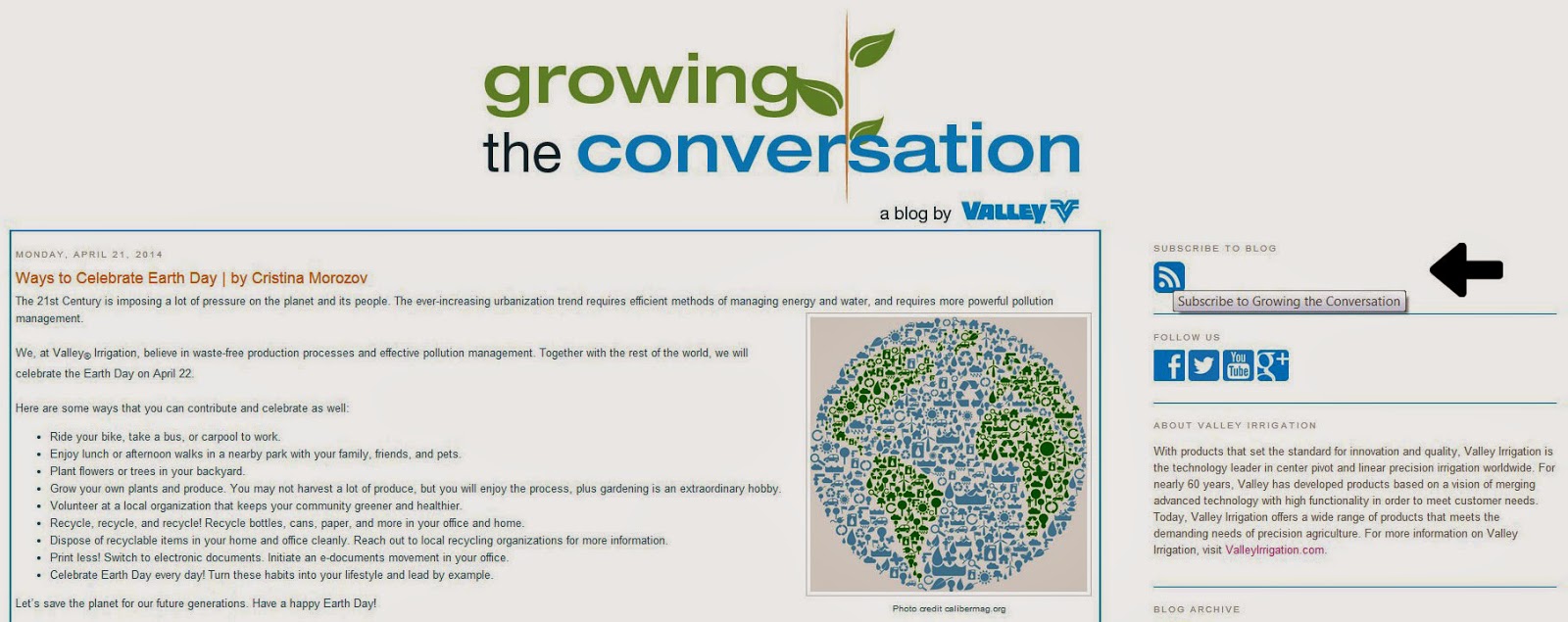
The moment you ALL have been waiting for is here (drum roll, please)…the second part of our how-to-find-Valley®-in-the-digital-world-and-beyond series! In our first installment, I walked you through how to set up a free Google Alert. This time, I’ll give you the play-by-play of setting up an RSS Feed so that you (yes, you!) can easily follow the Growing the Conversation blog! 

Many of you may already know what an RSS Feed is, but some of your may be asking, “What in the world is she talking about?” An RSS Feed is a way for blogs, news feeds, and other websites to push frequently updated information directly to you. Sounds simple, right? There is, of course, one catch: you must have an RSS Reader to capture those RSS Feeds! Like a moth to a flame. Or a cat to peanut butter.

Admittedly, setting up an RSS Feed used to be kind of a pain, and some magic web programming knowledge was typically needed. However, we’re well into the 21st century, and technology has become one of our closest friends, allowing us to get whatever we need in just a few clicks of a mouse or taps of a finger!

Follow these steps to set up your very own RSS Feed to easily follow the Growing the Conversation blog:

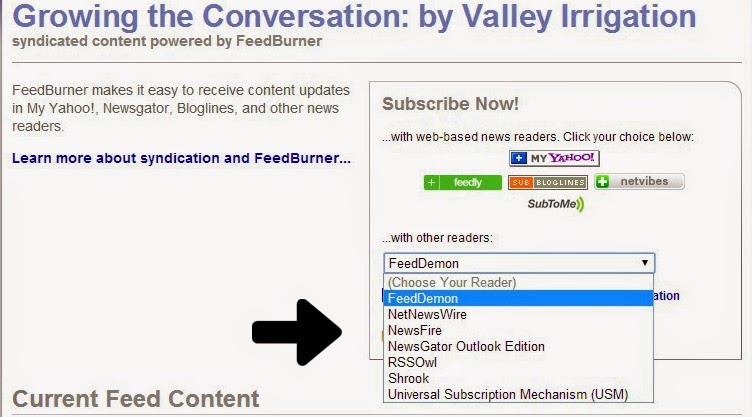
1. Get an RSS Reader. Some popular ones include FeedDemon, RSSOwl, and Feedly. If you have Microsoft Outlook, you already have an RSS Reader built in!

2. Find the site you want to subscribe to (hint, hint: this blog). Click on any link that resembles a “Subscribe to This Blog” or “Subscribe to News Feed” or just “Subscribe.”


3. (If you are using Outlook, skip to step 4.) If you are NOT using Outlook, find your installed RSS Reader from the list provided and skip steps 5-7. Follow the instructions for adding a new RSS Feed in your RSS Reader of choice.


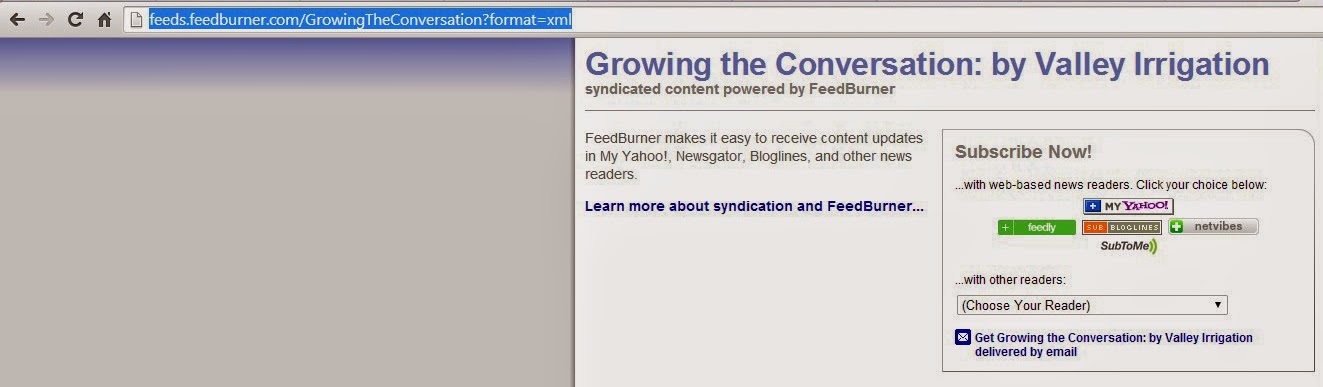
4. If you ARE using Outlook, click on the “View Feed XML” (or similar) link and follow steps 5-8.


5. Copy the web address (URL) in your browser’s address bar.


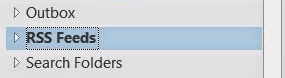
6. Navigate to Outlook and find the folder in the left-hand column called RSS Feeds (it will be somewhere below your main Inbox folder).


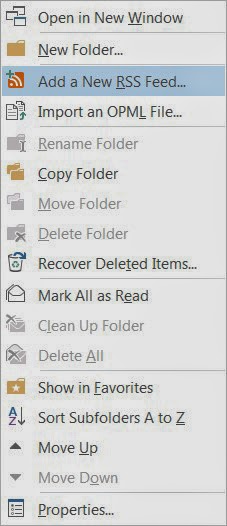
7. Right-click with your mouse on the RSS Feeds folder and choose Add a New RSS Feed.


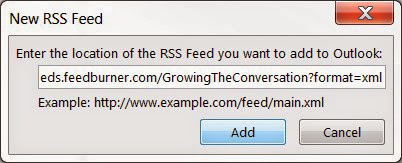
8. Paste the URL from step 5 and click Add.


And that’s all there is to it! Now, whenever we post a new blog post to the Growing the Conversation blog, you will be the first to know. Use this same tutorial to subscribe to other blogs, news feeds, and other websites.

Would you like to see other tutorials from the Valley bloggers? Let us know – drop us a line in the Comments box below!


Kelly Cox
Global Digital Marketing Manager

Kelly joined the Valley Irrigation Global Marketing Department in 2008. Her love of all things geek (steampunk furniture, anime, Doctor Who, and science fiction/fantasy literature, just to name a few) helped shape her appreciation for technology and the web. Kelly is a newlywed and new homeowner, where she shares her geekery with her husband. She considers herself a wine connoisseur (though, 3 buck Chuck is delicious!) and has a love of painting, dance, and singing.

Thursday, May 1, 2014

A Winning Formula from Valley Water Management | by Tyler Fields

With inflation on the rise and increased power costs, efficiency in pumping applications has reached critical mass. When it comes to the engineering and design of pump stations, Valley® Water Management has produced a winning formula. Our mission is not only to serve our dealers and customers, but also to always seek and implement the most efficient pumping solutions possible. 

It’s not uncommon for us to completely redesign a project just for cost comparison with an end game of keeping that dollar in your pocket. How does that work? We can save hundreds of horsepower through the use of booster stations, if applicable, which could save thousands of dollars per year.


Another huge money saver is a Variable Frequency Drive (VFD). VFDs are used in aiding the startup of large pumps, which can eliminate demand charges (based on your local power company). The use of VFDs greatly increases the life of your pump motor through a patented “slow start,” as well as byu maintaining pressure instead of wasting it.


Another great tool is Pump Connect™, a product that provides a secure back-up plan when you’re not around. It simply mounts on your center pivot/linear and connects to your pump, enabling it to shut down your pump if the pivot safeties out or is shut off remotely. This one tool saves power, water, and prevents your field from flooding.

VWM is here to help you in your custom applications. Contact your local Valley dealer and get your farm in on a winning formula t
oday!


R. Tyler Fields
Agricultural Engineer

Tyler, an agricultural engineer specializing in land and water resources, joined Valley Water Management in April 2013. He had worked in the Valley network for many years, enabling him to work closely with the agricultural irrigation community in assessing the needs of the farm and other Ag industries. Tyler grew up on a dairy farm in south Florida and also has been involved in the daily operations of ranches and row crop farms. Working for VWM allows him to pair his education and his love for agriculture.